
Written by Naomi Wallace
A biblical downpour cascades down the stone steps, splashing under scrambling feet that hurry towards the swinging doors. You don’t stop to admire the majestic columns, or marvel at the grand neoclassical façade; the promise of shelter overwhelms. It’s a rainy September in London, and what else do the intellectual, erudite crowd do in this weather except visit a museum? That’s what you tell yourself as you step inside, your ineffectual umbrella dripping woefully on the glistening floor. Really you just needed something to do amidst the deluge, and this was the closest option in this godforsaken city that won’t cost you your firstborn.
Clearly the sodden throng of people milling around the entrance had the same idea. You stare around ambivalently at the swirling staircases and dizzying glass ceiling. A giant marble greenhouse full of freshly watered tourists. There’s something so clinical about the Great Court, with its spotless white walls and hushed murmurs. It doesn’t transport you into the past; it reeks of new money. Soft footsteps echo through the vast space, migrating from room to room, each one filled with endless cabinets of history there to mindlessly gawk at. For the most extensive collection in the world, there is a disconcerting coldness to the building that houses it. From where you’re standing, the British Museum is nothing but a drab, lifeless place. But at least you’re out of the rain.
Ambling aimlessly through the eons and across the antipodes with a bored indifference, the galleries blur together until you cannot be sure which you’ve yet to see. One moment you are strolling through imperial China, Ancient Egypt the next, baroque France- wait, you’ve seen this one already, time to double back. Countless objects arranged in orderly rows, a spice rack in a neat-freak’s kitchen. All an uninspiring assemblage of items for which the collectors, and curators, evidently felt no passion beyond adding another trophy to the case. Maybe that’s a bit harsh- you suppose they are easier to catalogue this way. You try to imagine them with their original owners, the warmth of the fingertips that held them, imagine what they would feel like in your hands, centuries later, different but the same. Who received their daily bread from that porcelain plate, how many heads of long Roman hair was that comb dragged through? You stare and stare but feel numb and disconnected from it all. The glass barrier between your humanity and these artefacts has sucked the life out of them.
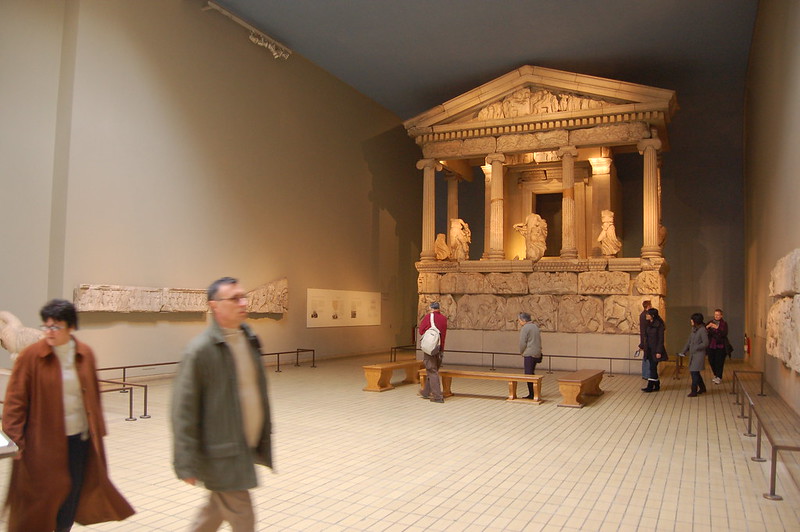
Has the rain ceased yet? you wonder as you return to the grand foyer, eyes adjusting to the bright white surroundings, and are disappointed to see it still assaults the glass roof unrelentingly. Next stop then, and you enter a corridor lined with sculptures that feel strangely familiar. You try to pluck the recollection from your days of history classes, but only the faint image of a tabloid newspaper and a subtle whiff of controversy stirs in the mind. So, you curiously approach an employee, but the handmaid of the museum answers your questions with a stiff blankness, a rehearsed answer of unwavering loyalty to the institution. Grey marble set against grey walls. Was Ancient Greece really this dull? You remember reading somewhere (and by somewhere, you mean a ten second online video) that the marble would have been painted, and envision the vibrant hues of gold, cerulean, crimson, adorning the walls of the Parthenon Temple. Now, in their monochrome, it is like standing in a room of ghosts. A displaced palimpsest of a glorious time, drained of colour in this lustreless place.
It is not long before you see her. Her peplos drapes effortlessly, soft to the touch as you momentarily forget it is crafted from marble. Her hair is pulled behind her in an intricate braid, falling gracefully down her back. The sixth caryatid, who once proudly bore the weight of the Erechtheion, five others by her side. Somewhere, in Athens, are these five, missing their lost sister. They have left a space for her return, but she remains in her lonely prison, snatched by greedy hands, stripped from her home. They grieve, incomplete, maidens who once held up a temple that would collapse in her absence. You squint, and for a brief second are convinced you see a tear spill onto her cheek. Blink and it’s gone, must have been a trick of the light.
Leaving her behind, just another of the millions to pass by her over the years, you consult your flimsy paper map to find your next stop. Clearly holding it in the same hand as your umbrella was an oversight, you realise too late as you squint to make out the words on the disintegrating mush of pulp. How long have you been here anyway? Too long, probably, but time feels uncanny in this discombobulating labyrinth. You haven’t even seen the Africa collections yet, where is it on the map… ah! By some divine luck it has remained just about distinguishable, and you gain your bearings, follow the downwards arrow, to find a treasure trove… tossed carelessly into a basement. Bronze reduced to mud as it yearns for the palace walls from which it was seized. The guilty conscience of the museum. A vault of looted gems, tucked away neatly in a corner. They didn’t even have the heart to display it above ground.
A quick trip to another continent, you end up on Easter Island, named affectionately, or possessively, by a foreigner who commemorated the day of resurrection with a slaughter. Towering over you, a statue, you read, given as a gift to Queen Victoria, but not by its original owner. A firm brow, wide nose, a downturned mouth, defiant. Hoa Hakananai’a. Stolen friend. It sounds ugly, the syllables curdling in your English mouth. A wound ripping open each time it is uttered. The soul of a nation, pilfered in return for an unwanted moniker. You wonder if anything in this British Museum is actually British, or whether the whole place is merely a burial ground for everything the country nicked during the heyday of empire and can’t be bothered to give back.
Legs aching, you decide, tired and disillusioned, to call it a day. There is still an array of galleries to cover, endless displays to see, but hey, there’ll always be more bad weather. These objects will wait, frozen in time, eternally, for your return, but they long for their own return, to the bleeding hearts of their homes which will breathe life back into them. Dizzy and disorientated, you finally trace your steps back to the entrance. Grimacing, you step out into the rain.
A note on context:
While this piece is satirical, the concerns voiced about the British Museum, the appropriation of artefacts from colonised nations, and its role in perpetuating imperial narratives, are significant and sincere. For so many nations and groups, this institution is the cause of great pain and loss, and a great number of these are still fighting for their stolen objects to be returned. For more information and perspectives on this, I have linked some articles below:
https://www.aljazeera.com/features/2021/10/12/stealing-africa-how-britain-looted-the-continents-art
https://www.theatlantic.com/science/archive/2017/09/hans-sloane-british-museum/539763/
https://www.vogue.co.uk/arts-and-lifestyle/article/should-british-museums-return-colonial-artefacts
Featured image credit: “Temple & statues from the Elgin Marbles at the British Museum” by Chris Devers is licensed under CC BY-NC-ND 2.0.
 Retrospect Journal